
How High Should You Mow Tall Fescue in Roanoke, VA?
By Elite Lawn Care Team. Last updated: October 21, 2026. Mowing guidance cites Virginia Cooperative Extension (VCE) and Virginia Tech. Frost data cites the National Weather Service.
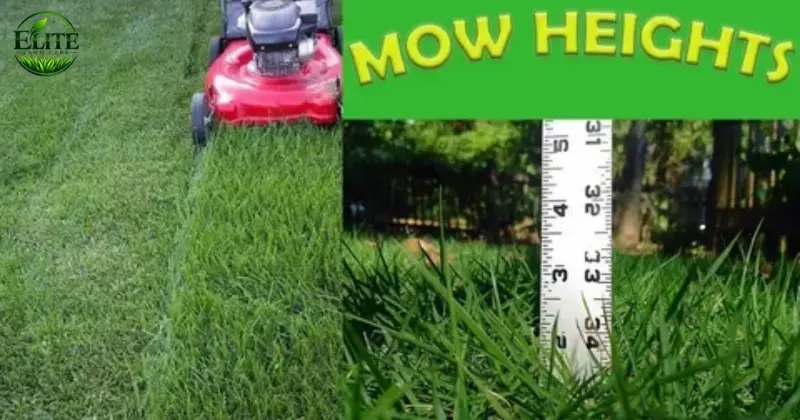
Mowing height is the height of the grass after the mower cuts it. For tall fescue, the most common lawn grass in Virginia, VCE lists a mowing height of 3 to 4 inches. The right height keeps the lawn dense and helps it handle summer stress.
Quick answer: Mow tall fescue at 3 to 4 inches. Cut it when the grass reaches about one and a half times your mower setting, for example at 4.5 inches when the mower is set to 3 inches. Never remove more than one-third of the leaf blade in one mowing. Keep the blade sharp, and mow when the grass is dry.
This guide gives the mowing height by situation, the mowing schedule that follows from the one-third rule and the seasonal changes for Roanoke lawns. It also covers new lawns, blades, clippings and common mistakes.
The height comes first, with a table for each situation.
The Right Mowing Height for Tall Fescue
VCE’s Gardener Handbook lists 3 to 4 inches for tall fescue in its table of turfgrass mowing heights. VCE’s SMART Lawns booklet also advises setting the mower blade at 3 to 4 inches for fescue.
| Situation | Mowing height | Basis |
| Established lawn | 3 to 4 inches | VCE Gardener Handbook, VCE SMART Lawns |
| Hot or dry weather | Upper end of the range | VCE advises raising the height before a predictable stress period. This guide treats the upper end as the summer setting, because VCE gives no separate summer number |
| New seeding | First mowing when the grass reaches 4 inches, cut to 3 inches | VCE Fall Lawn Care publication |
| Overgrown lawn | Lower the deck over two or three mowings | Follows from the one-third rule |
Some older Extension materials list lower heights, such as 2 inches. VCE’s current Gardener Handbook table and SMART Lawns booklet give 3 to 4 inches, so this guide uses that range.
The height also decides when you mow, which the one-third rule explains.
The One-Third Rule: When to Mow
The one-third rule says to never remove more than one-third of the leaf blade in one mowing. VCE states that mowing frequency should follow seasonal growth, often enough that no more than one-third of the green leaf is removed.
The table applies the rule to each mower setting. These figures are calculated from the rule and are not VCE numbers.
| Mower setting | Mow when the grass reaches | Inches removed |
| 3 inches | 4.5 inches | 1.5 |
| 3.5 inches | 5.25 inches | 1.75 |
| 4 inches | 6 inches | 2 |
A lower setting does not reduce how often you mow. At a 1-inch setting, only half an inch of growth can build up before the next cut.
Mowing too often has a cost as well. VCE states that excessive mowing frequency reduces shoot yield, rooting and food reserves.
The rule protects more than the leaf, as the next section shows.
Why Taller Mowing Works for Tall Fescue
Virginia Tech lists tall fescue as having the deepest root system among the cool-season lawn grasses and excellent drought avoidance. Mowing at the recommended height keeps that advantage.
VCE also states that mowing below the adapted height encourages weeds such as annual bluegrass and crabgrass. Taller grass keeps the lawn dense, which leaves less room for weeds.
Height needs to change with the season, so the next section follows the year.
Seasonal Mowing for Roanoke Lawns
Tall fescue is a cool-season grass. VCE lists 60 to 75°F as the ideal range for shoot growth, and 40°F as the lower limit for cool-season shoot growth.
| Season | What to do |
| Spring | Growth is fast, so mow often enough to follow the one-third rule |
| Summer | Growth slows. VCE advises raising the cutting height 4 to 6 weeks before a predictable stress period. Mow as needed, and avoid mowing during drought |
| Fall | Growth picks up again. Keep the 3 to 4 inch range |
| Late fall and winter | Growth slows as temperatures drop toward 40°F. The National Weather Service lists October 22 as the average first 32°F freeze in Roanoke (1912 to 2016 record). Mowing ends when the grass stops growing, which is an inference and not a VCE rule |
New and overseeded lawns follow separate rules in their first weeks.
Mowing a New or Overseeded Lawn
VCE’s Fall Lawn Care publication states that the recommended height for tall fescue is 3 inches, so a new lawn gets its first mowing when it reaches 4 inches. It also states that the blade must be sharp and the soil surface firm.
Mow a new seeding only when it is dry. A dull blade or soft soil can pull seedlings out of the ground. Our guide to when to overseed a fescue lawn in Roanoke gives the seeding dates.
The condition of the blade matters as much as the height.
Blade Sharpness, Dry Grass and Clippings
A VCE fact sheet from Prince William County gives these mowing rules:
- Sharpen mower blades about every 10 hours of use, or every 10 to 20 mowings.
- Wet grass tends to dull blades, and a dull blade contributes to lawn diseases.
- Avoid mowing during drought or when the leaf blades are wet.
Clippings do not need to be bagged. The Gardener Handbook states that collecting clippings from a home lawn is not advised and that clippings are not a major contributor to thatch. VCE Henrico’s SMART Lawns booklet says to recycle clippings, and VCE lists their value at about one-fourth to one-third of the lawn’s yearly nitrogen need, depending on the publication.
Setting the mower correctly is the next step.
How to Set Your Mower Height
Mower deck settings differ between models, so the number on the lever may not match the real cutting height. Use this practical check:
- Set the deck to the position you expect to give 3 to 4 inches.
- Mow a small test area.
- Measure from the soil to the tip of the cut blades with a ruler.
- Adjust the lever and mark the correct position.
Most height problems come from a few repeated errors.
Common Mowing Height Mistakes
- Cutting too short. VCE ties mowing below the adapted height to more annual bluegrass and crabgrass.
- Removing more than one-third at once. Mow more often, or lower the deck gradually.
- Using a dull blade. It tears the grass and contributes to disease.
- Mowing wet grass or during drought. VCE advises against both.
- Bagging clippings. VCE does not advise collecting them from a home lawn.
- Skipping the seasonal change. Raising the height before heat follows VCE guidance.
If the height is correct and the lawn still struggles, the cause is probably elsewhere.
When Mowing Height Is Not the Problem
Brown patches, thin areas and spreading damage often come from heat stress, brown patch fungus, grubs or compacted soil. Our guide to why grass turns brown in Roanoke shows how to tell the causes apart.
Some homeowners prefer to hand off the mowing itself.
DIY or Professional Mowing in Roanoke
A homeowner with a sharp mower and a ruler can follow this guide. A professional service helps with large or sloped lawns and a tight schedule.
Ask any provider these questions:
- What height will the mower be set to?
- How often are the blades sharpened?
- How often will the crew mow in spring and fall?
- Are clippings left on the lawn?
Elite Lawn Care serves Roanoke, Salem, Vinton, Cave Spring, Hollins and Bonsack. For a free lawn assessment, call or text +1 (804) 485-4915 or see our lawn mowing service in Roanoke.
Mowing is one part of a seasonal lawn plan.
Related Lawn Topics
- When to fertilize a lawn in Roanoke: the fall nitrogen schedule.
- Best grass seed for Roanoke lawns: choosing the right variety.
- How much lawn care costs in Roanoke: mowing price ranges.
Frequently Asked Questions
What height should I mow tall fescue?
VCE lists 3 to 4 inches for tall fescue. Use the upper end of the range in hot, dry weather.
How often should I mow tall fescue?
Mow often enough that you never remove more than one-third of the leaf blade. A lawn kept at 3 inches needs mowing when it reaches 4.5 inches. Growth is faster in spring and fall and slower in summer.
Is 2 inches too short for tall fescue?
VCE’s current mowing height table lists 3 to 4 inches. VCE ties mowing below the adapted height to more annual bluegrass and crabgrass.
Should I mow my fescue lawn shorter before winter?
VCE does not list a separate fall cutting height in the publications reviewed. Keep the 3 to 4 inch range while the grass is growing.
Can I mow after rain?
VCE advises against mowing when the leaf blades are wet. Wet grass also dulls blades faster.
Should I bag clippings?
No. The Gardener Handbook states that collecting clippings from a home lawn is not advised, and clippings are not a major contributor to thatch.
How often should I sharpen the mower blade?
VCE advises sharpening about every 10 hours of use, or every 10 to 20 mowings.
When should I first mow a new fescue lawn?
When the grass reaches 4 inches. Cut it to 3 inches, with a sharp blade and a firm soil surface.