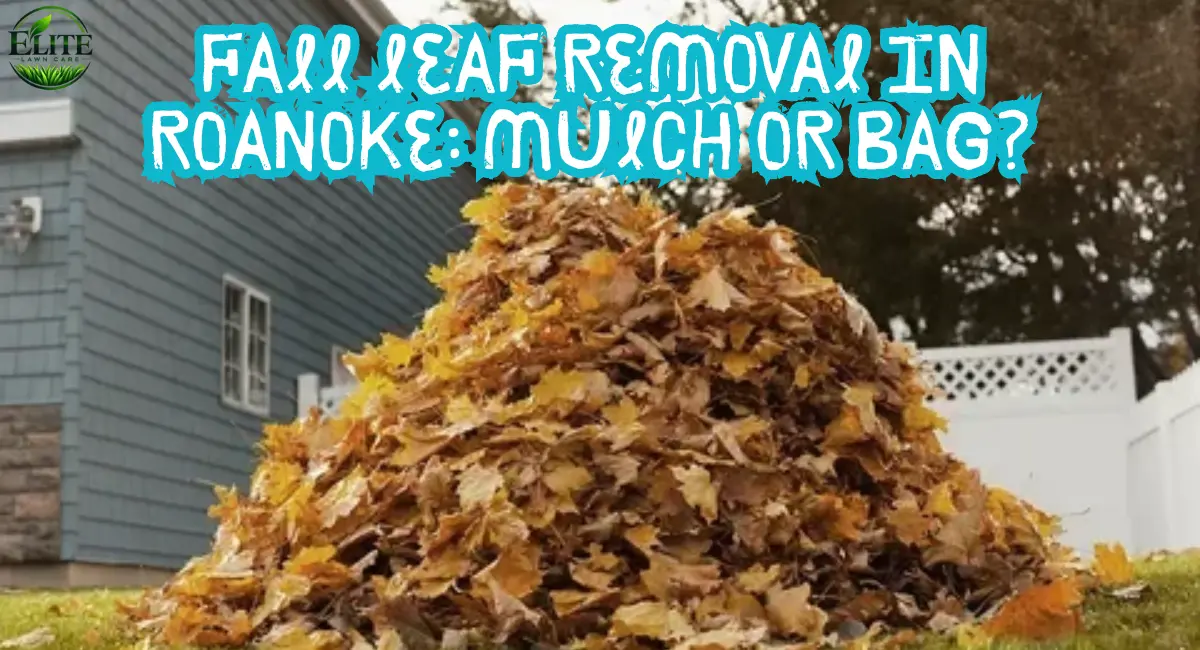
Fall Leaf Removal in Roanoke: Mulch or Bag?
By Elite Lawn Care Team. Last updated: October 18, 2026. Lawn guidance cites Virginia Cooperative Extension (VCE) and other university extension programs. Disposal rules cite the City of Roanoke.
Fall leaf removal is the process of clearing or shredding fallen tree leaves so they do not smother the grass. There are two methods. Mulching means mowing the leaves into small pieces that settle into the turf. Bagging means collecting the leaves and disposing of them. The right choice depends on how many leaves fall and how wet they are.
Quick answer: Mulch leaves with a mower when they are dry and you can still see about half of the lawn surface. Bag or remove them when less than half of the lawn is visible, or when the leaves are wet and matted. In Roanoke City, bagged leaves must go in biodegradable paper bags. The City does not collect loose leaves or leaves in plastic bags.
This guide gives a decision table, mulching steps, bagging criteria, Roanoke City disposal rules, a leaf timeline and common mistakes.
The decision starts with how much of the lawn the leaves cover.
Mulch or Bag? A Decision Table
The University of Minnesota Extension recommends mulching tree leaves until you can see about half of the lawn surface. When less than 50% of the lawn is visible, it recommends bagging the leaves for composting off-site.
| Condition | Best choice | Reason |
| Dry leaves, more than half of the grass visible | Mulch | Shredded leaves settle into the turf and break down |
| Less than half of the lawn visible | Bag or remove | Thick leaf litter can harm the lawn in spring |
| Wet, matted leaves | Wait for dry weather, or bag | Wet leaves are harder to mulch, and extension guidance advises mowing when the canopy is dry |
| Heavy leaf drop under mature trees | Mulch in several passes, then bag the excess | One pass rarely handles a thick layer |
The 50% rule exists because of what leaves do to a growing lawn.
Why Leaves Matter for a Fescue Lawn in Fall
VCE describes fall as an important transition period for turfgrass growth and development. In fall, cool-season grasses such as tall fescue grow new shoots, store carbohydrates and produce roots. Leaves that cover the turf block the light the grass uses during this period.
The University of Minnesota Extension also warns that excessive leaf litter left on the surface can harm the lawn in spring. Wet leaves mat down and can smother the grass beneath them.
Mulching handles most leaf loads and is the simplest method, so it comes first.
How to Mulch Leaves into a Fescue Lawn
- Wait for dry leaves. The University of Minnesota Extension advises mulching when leaves are dry. UConn IPM advises mowing leaves only when the turfgrass canopy is dry.
- Use a sharp blade. VCE states that a dull mower blade tears grass and drains the plant’s stored energy.
- Keep the normal mowing height. VCE lists 3 to 4 inches for tall fescue. Follow the one-third rule for the grass itself, which means removing no more than one-third of the leaf blade per mowing.
- Make a second pass. The University of Minnesota Extension recommends a double pass for a finer mulch. Michigan State University Extension notes that a mulching mower can handle up to 6 inches of leaves in one pass, while a traditional mower may need several trips.
- Check the result. Rake up any clumps or mats that remain on the surface.
- Repeat as leaves fall. A University of Minnesota Extension educator suggests mowing every 10 to 14 days during fall to prevent buildup.
Homeowners who prefer to hand off the work can use a lawn mowing service in Roanoke.
Mulching also changes what happens in the soil.
What Mulched Leaves Do for the Lawn
- Nutrients. Mulched leaves return nitrogen, potassium and phosphorus to the soil. They return less nitrogen than grass clippings, according to the University of Minnesota Extension.
- Soil structure. Decomposing leaves improve soil structure, water infiltration, moisture retention and root growth.
- Weed suppression. Mulched leaves cover bare spots and inhibit weed seed germination.
- No thatch buildup. UConn IPM cites research showing that mulching leaves into turf does not contribute directly to thatch buildup.
- Wildlife. UConn IPM notes that many beneficial insects overwinter in leaf litter.
Michigan State University Extension reports that its research shows mulching leaves into turf is good for lawns.
Mulched leaves do not replace a soil-test-based fertilizer plan. VCE’s fall nitrogen program for cool-season lawns still applies. This point is an inference from the extension figures above, not a VCE statement.
Some conditions favor bagging instead.
When to Bag or Remove Leaves
Bag or remove leaves when any of these apply:
- Less than half of the lawn surface is visible.
- The leaves are wet and matted and the mower cannot shred them.
- Clumps remain after two passes.
- The layer under mature trees is too thick to mulch in one visit.
Rake the leaves onto a tarp, blow them into piles or use a vacuum. Compost them, or dispose of them under local rules.
Disposal rules in Roanoke City are specific, so they come next.
Roanoke City Leaf Disposal Rules
The City of Roanoke collects bagged leaves only. Its leaf collection page lists these requirements:
- Leaves must be in biodegradable paper leaf bags. The City does not pick up leaves in plastic bags.
- Bags go out on the same day as regular trash and recycling collection. There is no limit on the number of bags.
- The City does not collect loose leaves. Homeowners can hire a private contractor and should notify the City at 540-853-2000, Option 1.
- Raking leaves into the street or the City’s right-of-way violates City code. After a 72-hour removal notice, the City may hire a contractor and charge the property owner a $100 administrative fee plus the contractor cost.
In 2025, collection ran in four weeks between November 17 and December 18, with no collection during Thanksgiving week. Check the City’s leaf collection page for the 2026 schedule. Earlier City notices also list mulch mowing, composting and disposal at the Roanoke Valley Resource Authority as alternatives. Confirm the current options before you use them.
Salem, Vinton and Roanoke County may have different rules. Contact your locality before you bag.
Property owners who want contractor pickup can use a yard cleanup and leaf removal service in Roanoke.
A simple calendar keeps all of these steps in order.
Leaf Removal Timeline for Roanoke Lawns
| Stage | What to do |
| Early leaf drop | Mulch leaves as they fall while the layer is light |
| Peak leaf drop | Mow often enough to prevent buildup, and bag when less than half of the lawn is visible |
| After most leaves have fallen | Do a final mow and cleanup, and bag leaves in paper bags if you live in Roanoke City |
| Before winter | Check that no wet mat of leaves is covering the turf |
Leaf drop timing varies with tree species and weather, so follow what your lawn shows and not a fixed date.
Most leaf problems come from a few repeated errors.
Common Leaf Removal Mistakes
- Mowing wet leaves. Wet leaves clog the mower and leave clumps.
- Using one pass on a thick layer. The leaves stay large and cover the grass.
- Using plastic bags in Roanoke City. The City will not collect them.
- Raking leaves into the street. This is a code violation with a fee.
- Mowing with a dull blade. It damages the grass during peak fall growth.
- Leaving heavy mats under trees all winter. The University of Minnesota Extension warns about spring damage from excess litter.
These tasks take time and equipment, so many homeowners compare doing the work themselves with hiring it out.
DIY or Professional Leaf Removal in Roanoke
A homeowner with a few trees and a mulching mower can handle most leaf loads. Professional help makes sense for properties with heavy tree cover, large lots or limited time.
Ask any provider these questions:
- How are the leaves disposed of?
- How often will the crew return during leaf drop?
- Does the service include mowing the leaves into the lawn or only removal?
- Does the service follow the City’s paper bag rules?
Elite Lawn Care serves Roanoke, Salem, Vinton, Cave Spring, Hollins and Bonsack. For a free lawn assessment, call or text +1 (804) 485-4915 or use the contact page.
Leaf removal is one part of a wider fall plan.
Related Fall Lawn Topics
- How to prepare your lawn for winter in Roanoke: the final steps before dormancy.
- Fall lawn care checklist for Roanoke homeowners: the full seasonal sequence.
- Fertilization and weed control in Roanoke: fall nitrogen timing for cool-season lawns.
Frequently Asked Questions
Should I mulch or bag leaves on my lawn?
Mulch leaves when they are dry and you can still see about half of the lawn surface. Bag or remove them when less than half of the lawn is visible, or when the leaves are wet and matted.
Can I leave leaves on my lawn over winter?
A thin layer of shredded leaves settles into the turf. The University of Minnesota Extension warns that excessive leaf litter can harm the lawn in spring, so remove thick or matted layers.
How many leaves can I mulch into the lawn?
The University of Minnesota Extension recommends mulching until about half of the lawn surface remains visible. Michigan State University Extension notes that a mulching mower can take up to 6 inches of leaves in one pass.
Does Roanoke pick up loose leaves?
No. The City of Roanoke collects only leaves in biodegradable paper bags. Homeowners can hire a private contractor for loose leaves and should notify the City.
Can I use plastic bags for leaves in Roanoke?
No. The City does not collect leaves in plastic bags.
Do mulched leaves cause thatch?
No. UConn IPM cites research showing that mulching leaves into turf does not contribute directly to thatch buildup.
Can I rake leaves into the street?
No. In Roanoke City it violates City code, and the City may charge a $100 administrative fee plus contractor cost after a 72-hour notice.